Tenor Ukulele — "Ginkgo"
| Scale Length | 17" |
| Back & Sides | Koa |
| Top | Sitka Spruce |
| Accents | Indian Rosewood |
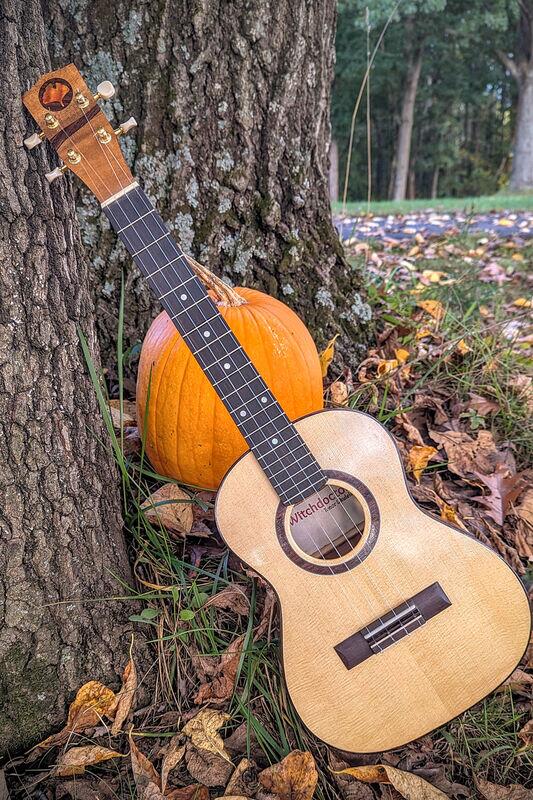
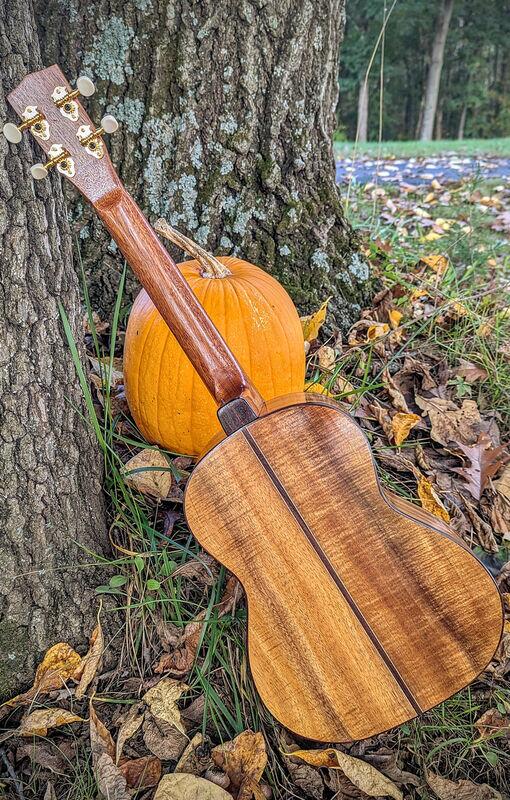
This build was an exploration for me. After a trip to the islands of Hawaii a few years ago I've been wanting to build a ukulele. I went into an instrument builder's shop there and we talked for quite a while. I built a StewMac concert kit to learn a bit about the instrument first. Then I got a few plans and books as reference material and used those as a starting point for this design.
I love the beautiful warm sounds of Koa but decided to pair it with spruce to give it a bit more punch and was hoping for a bit of both to round it out. I think I achieved that goal.
The Koa wood came from Stewart-MacDonald and did not look very figured when I got it but boy did it come out nice. I wish I had gotten more. I first tried to make a top out of Red Spruce but the sound hole chipped out horribly. I ended up grabbing an old Sitka Spruce top that had been in my shop for probably 20 years — a guitar top I had botched. See a pattern here? We live and learn and change tactics next time as these things happen. The neck is a bolt-on neck so I beefed up the heel to support the inserts. The body shape is based on the Martin tenor outline. I'll design my own in the future. Baby steps. The bracing and neck and other parts are a bit of a mishmash from other plans.
I decided I wanted to try my hand at using a CNC router for this build. I wanted to get more precision on some tasks. I especially have a tough time cutting inlay lines smoothly — I wander and it looks sloppy, which is okay but not as professional. I built myself an MPCNC from V1 Engineering for the task. I struggled a LOT and it increased the build time significantly. I ended up having to back off my lofty goals and choose my battles. I used it for the rosette inlay, the headstock inlay, and making templates out of acrylic for the headstock routing. I took my time on each step and tried to learn. For example, the ginkgo inlay I had to cut out quite a few times on scrap wood to figure out how to do it and how tight to make it. In the end I decided to actually leave a gap and fill it darker to give it a border instead of a tight inlay. I think it looks better this way — not what I was expecting. Then I cut out a bunch of ginkgo leaves out of figured maple hoping I could come up with an attractive dye and play with various finishing techniques. The chosen orange one was the best. I dyed it with two different stains, sanding back in between as folks on the internet suggest. Then I played with various stages of depth of inlay into the headstock veneer and finishing techniques — just CA, shellac and CA, tru-oil, etc. I ruined quite a few by sanding through, including a very nice one where I had not set the inlay deep enough. Live and learn. Exploration is the fun part and where I learn. I think it came out great in the end.